Using AI to Write Better Engineering Reports (Without Losing Your Professional Voice)

Using AI to Write Better Engineering Reports (Without Losing Your Professional Voice)
The Question Every Engineer Is Asking
You have probably already used an AI writing tool for something. A personal email, a summary of a long document, maybe a LinkedIn post. And at some point, almost certainly, a thought has surfaced: could I use this for work?
For engineers, that thought comes with an immediate qualification. Engineering reports are not personal emails. They carry professional weight. Clients act on them. Contractors are instructed by them. Decisions are made — sometimes safety-critical ones — based on what is written in them.
This article is not here to dismiss that concern. It is well-founded. But it is also answerable. Used correctly, AI writing tools can materially improve the quality of your engineering reports without compromising your professional voice or professional responsibility. The key word is correctly.
Where AI Genuinely Helps in Engineering Reports
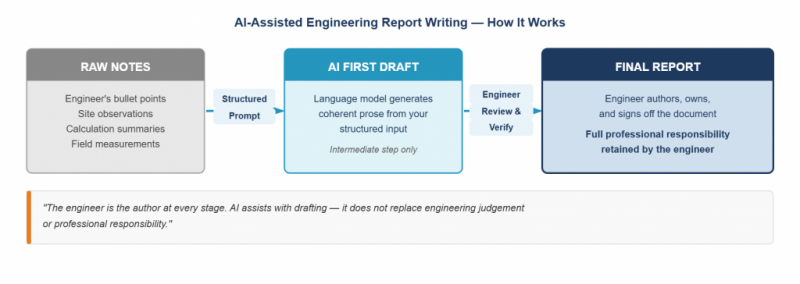
For UK civil and structural engineers, AI civil engineering reports are becoming a practical reality — not a distant prospect. The engineers who get the most value from AI writing tools are not the ones who hand over a blank page and ask for a report. They are the ones who bring structured thinking to the tool and use it to do the work they find most tedious: turning good engineering thinking into well-organised, clearly expressed prose.
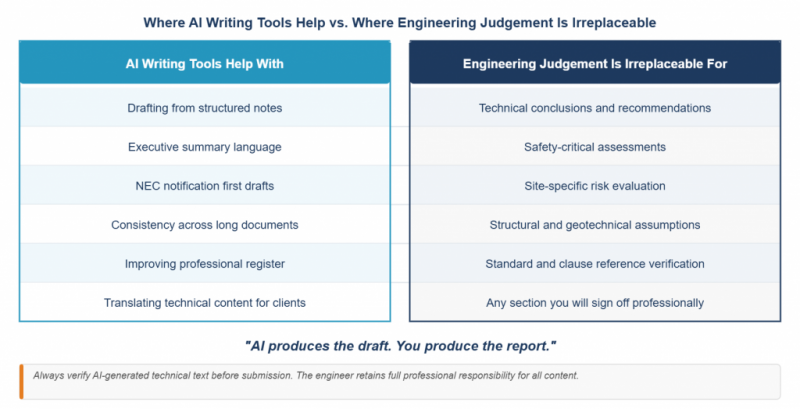
Drafting from structured notes. If you have clear bullet-point notes of what happened on site, what the findings were, and what the implications are, a well-crafted prompt can turn those into a coherent first-draft section in seconds. You review rather than compose from scratch — significantly faster and cognitively easier.
Executive summaries. Summarising a 40-page technical report for a client audience is one of the tasks engineers find most difficult. AI tools handle this well when given the right input. Feed in your key findings, decisions, and recommendations; specify the audience; ask for a defined length. The result is usually a solid first draft that needs refinement, not a complete rewrite.
NEC correspondence. NEC3 and NEC4 notification formats are sufficiently formulaic that AI tools can produce strong first-draft text. Early Warning Notices, Compensation Event notifications, and Programme notifications all follow recognisable structures. You must verify all clause references against your specific contract — that check is non-negotiable.
Consistency across long documents. On documents produced by multiple authors over time, AI can smooth inconsistencies in tone, tense, and terminology. This is an editorial task, not an engineering one, and AI handles it well.
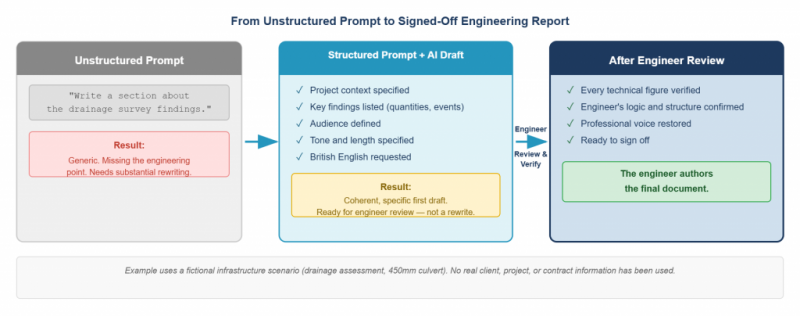
The difference between poor and useful AI output is almost always the quality of the prompt. The fictional drainage scenario below illustrates this:
Unstructured: “Write a section about the drainage survey findings.” — Generic, thin, unusable without substantial rewriting.
Structured: “Write a technical summary paragraph for an infrastructure design report. Context: preliminary drainage assessment, flood risk area. Findings: (1) 450mm culvert operating at 94% capacity under 1-in-30-year event; (2) development increases impermeable area by 1,800m²; (3) SuDS attenuation required. Audience: client’s planning team. Tone: technical but accessible. Length: 150–180 words.” — Coherent, specific, ready for engineer review.
Where AI Falls Short — And Where Not to Use It Unreviewed
The same capability that makes AI useful — confident, fluent prose generation — is also its most significant risk in engineering contexts. AI writing tools do not know whether what they are writing is true. They produce text that reads as accurate because they have been trained on vast amounts of accurate text.
Hallucinated references. AI tools will sometimes cite specific clause numbers, standard references, or guidance documents that either do not exist or do not say what the AI claims. A report section that references a fictitious BS standard clause is worse than no reference at all — it is a liability.
Narrative-wrapped technical errors. An AI tool presented with a structural calculation scenario may produce a paragraph that reads as a confident technical summary but contains an error in the underlying assumption. The prose is coherent; the engineering is wrong.
Inappropriate generalisation. AI has no awareness of site-specific conditions, local authority requirements, client-specific obligations, or the particulars of your contract. Anything it produces about those topics is a generalisation at best.
The practical rule: AI text is useful for structure, language, and communication. It is not a substitute for engineering judgement. Do not use it unreviewed to generate technical conclusions, safety assessments, quantified risk statements, or any section where an error could have professional or contractual consequences.
AI tool capabilities, professional body guidance, and employer policies in this area are evolving. Always verify current requirements with your professional body, employer, and relevant client contracts before using AI tools in professional work.
Prompting Techniques for Better Engineering Report Text
The quality of what you get out of an AI writing tool is almost entirely determined by the quality of what you put in. Engineers who find AI tools frustrating or unreliable are typically using prompts that are too short and too generic.
Technique 1: Specify context, audience, and constraints. Without these, the AI defaults to a generic register. With them, it calibrates to your actual requirements.
“Write a technical assessment paragraph for a Stage 2 geotechnical report. Context: residential development on brownfield land with contaminated made ground to approximately 2.5m depth. Key finding: standard strip foundations not viable; piled solution recommended. Audience: structural engineer coordinating with the design team. Tone: technical, direct. No hedging. 120–150 words.”
Technique 2: Give it the logic, not the blank canvas. Write your key points as bullet notes, then ask the tool to turn them into prose. AI performs well when organising and expressing your engineering thinking, not inventing it.
Technique 3: Ask it to adopt a specific professional register. AI defaults to a mid-register tone. Engineering reports often need formal but clear, technical but not jargon-heavy prose.
“Rewrite the following paragraph in a formal professional register appropriate for a civil engineering client report. Remove any informal language, passive voice where it weakens the sentence, and unnecessary hedging. Preserve all technical content and specific figures exactly.”
Technique 4: Use it to improve, not to originate. One of the most reliable uses is passing your own draft to the AI and asking it to improve the language while preserving the engineering content. This keeps your engineering logic in control while getting the prose benefit.
The before/after examples in this article use fictional project scenarios. No real client, project, or contract information has been used.
How to Maintain Your Professional Voice
The concern that AI-assisted text will not sound like you is understandable, but it is solvable — and addressing it is the same process as ensuring technical accuracy.
Read it aloud. Your ear will catch things your eye skips. Awkward phrasing, generic filler sentences, uncharacteristic hedging, and the subtle register differences that make AI-generated text feel slightly off — these all become apparent when you read aloud.
Challenge every specific claim. For every technical figure, standard reference, clause number, or factual assertion, ask: do I know this is correct? If the answer is no, verify it before it goes further. If it cannot be verified, remove it.
Strip out AI patterns. AI writing has identifiable habits: starting sentences with “It is worth noting that…”, three-part paragraph structures even when the content does not warrant it, balanced conclusions that hedge rather than commit. These dilute the directness that good engineering writing requires. Remove them.
Confirm the structure is yours. AI structures text based on patterns it has learned. That structure may not reflect your engineering logic. Restructure if necessary.
After a competent review pass, AI-assisted engineering text is indistinguishable from text you wrote yourself — because, at that point, you have authored it.
Conclusion
AI writing tools are not going to write your engineering reports for you. They are going to help you write them better and faster — if you bring the engineering, use structured prompts, and apply the professional review that the work requires.
The anxiety most engineers feel about AI-assisted writing is well-placed, but it is not a reason to avoid these tools. It is a reason to use them correctly. The professional voice concern dissolves when you read your own review pass. The credibility concern is answered by the verification step you apply to every technical claim. The responsibility question has a clear answer: it is yours, as it always was.
Used correctly, AI makes you more productive without making you less responsible. That is a worthwhile tool.
Professional Responsibility — The Non-Negotiable
AI-generated text must be reviewed and verified by a qualified engineer before submission. The engineer signing off any report retains full professional responsibility for its content.
This is not a caveat. It is the professional position under the ICE Code of Professional Conduct and the UK Standard for Professional Engineering Competence and Commitment. The engineer who signs the document owns every word in it — regardless of how that word was produced. A report that contains an error because an AI hallucinated a standard reference is not an AI error in any professionally meaningful sense. It is an engineer error.
AI tool capabilities, professional body guidance, and employer policies in this area are evolving. Always verify current requirements with your professional body, employer, and relevant client contracts before using AI tools in professional work.
EnginEdge is an independent resource and is not affiliated with or endorsed by the Institution of Civil Engineers (ICE).
This article was produced with AI assistance and reviewed by a qualified engineer.